Mail : info@bobparkinsconsultants.com Call Us : (916) 806-6580

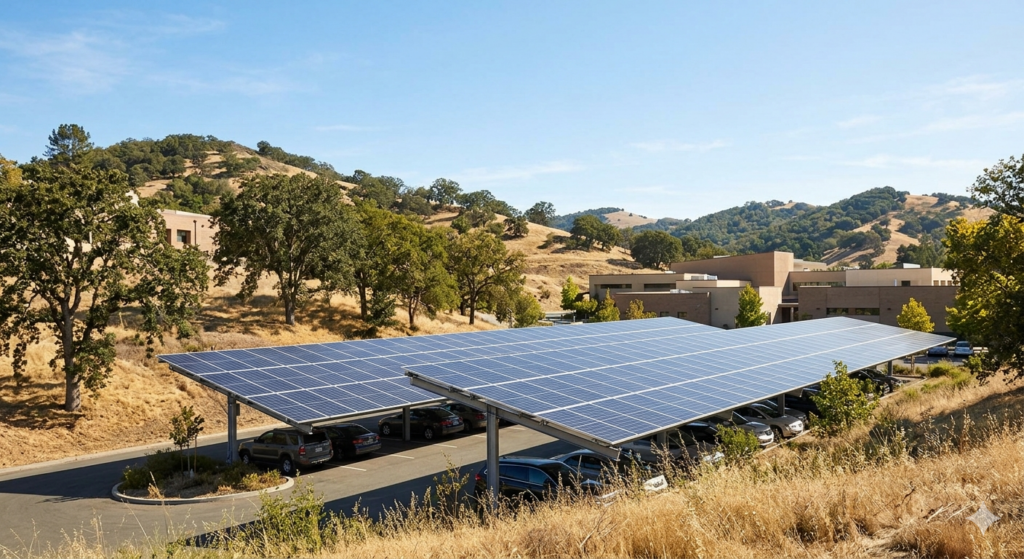
A third-party consulting firm (Bob Parkins Renewable Energy Consultants) worked with the Sierra Community College District (Sierra CCD) to issue an RFP for a customer-sited PV system. Proposed host sites included five building rooftops and a series of curved, S-shaped parking lots on the south side of the Rocklin, California, campus. We ruled out several of the proposed rooftops due to some combination of structural concerns, shading and the distance from the metered interconnection point. Also, production modeling clarified that the curved parking lots were not ideal host sites in terms of production efficiency, since it was impossible to orient modules uniformly to the south.
Our project team focused attention on Parking Lot J, a north-south–oriented parking lot adjacent to the athletic facilities that would allow for an optimal array azimuth. To reach the metered tie-in point, our design team developed an ac electrical design strategy that incorporates a cross-campus medium-voltage circuit, with step-up and step-down transformers. By design, we limited ac voltage drop on this 6.9 kV circuit to 0.5% or less.
To compensate for having ruled out several rooftops as host locations, we modified the dc equipment specifications to meet the project’s energy production requirements. To locate an 888 kW PV array in Parking Lot J, our design team substituted high-efficiency PANDA-series modules from Yingli Solar. (The campus bookstore roof hosts an additional 82 kW of PV capacity.) Two central inverters with a combined capacity of 750 kVA process power from the carport-mounted PV array.
Like most school clients, Sierra CCD wanted construction completed during summer months, when traffic on campus is lightest. Since school construction projects in California are subject to approval by the Division of the State Architect [DSA], we specified a preapproved solar support structure designed by National Carport Industries. Using a product with a DSA precheck number was critical for meeting the tight construction timeline.
We had to limit the solar support structures to 16 feet in height, due to wind loads and the use of a preapproved design. Our design team broke up the support structures to comply with this height restriction and to account for a subtle slope across the surface of the parking lot. Wide east-west breaks between the structures met the local fire department’s drive lane requirements.
During construction, crews encountered a heavy concentration of granite boulders under the parking lot surface. We had to bring in a contractor with a larger drilling rig to remove the rocks, causing a scheduling delay. To compensate, we established an on-site prefabrication area where we pre-panelized modules on rails. We subsequently lifted these six-module panels into position using a telescopic handler and mounted them to the purlins. The reductions in labor costs more than offset the increased material costs associated with the use of module rails.
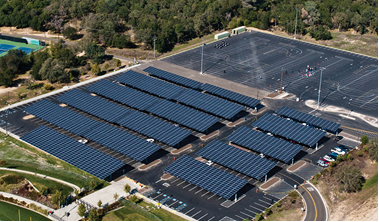
Parking Lot J To meet the project schedule, Borrego Solar chose DSA-preapproved solar support structures designed by National Carport Industries. The project primarily uses 40-foot-wide full tee carports, with a few 20-foot-wide cantilevered tee carports on the north edge of the lot.
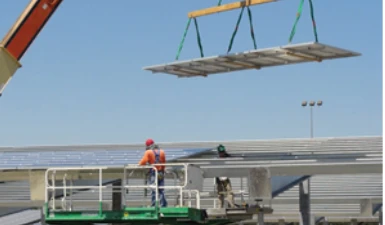
Preassembly Borrego’s installation crew uses a telehandler to lift panelized modules into place.